The Research Precarity Working Group is a collective grassroots initiative taking action to reduce the level and impact of employment precarity across research-related careers in higher education institutions.
Sign up to join the Research Precarity Working Group
Vision
To take collective action to reduce the level and impact of employment precarity in research, research professional, and technical roles.
Mission
- Build a strong national case for change to current employment practices.
- Advocate for improved support for colleagues facing precarity.
- Engage funders, HEIs and national bodies in sector-wide conversations and calls for action.
Join the Working Group
We welcome any contributions you can make, even just signing up to show your support.
As a member of the Working Group, you will be invited to bi-monthly meetings, can contribute outside of meetings, and have the option to participate in one or more focused workstreams:
- Workstream 1: Data & Evidence – Creating an evidence bank, conducting research on precarity, and mapping support.
- Workstream 2: Organising & Outreach – Building networks, promoting discussion, and engaging stakeholders.
- Workstream 3: Making the Ask – Coordinating calls to action with funders, institutions, and sector bodies.
Workstream 1: Data & Evidence
Objective: Creating an evidence bank, conducting research on precarity, and mapping support.
Workstream 2: Organising & Outreach
Objective: Building networks, promoting discussion, and engaging stakeholders.
Workstream 3: Making the Ask
Objective: Coordinating calls to action with funders, institutions, and sector bodies.
What We Mean by Precarity
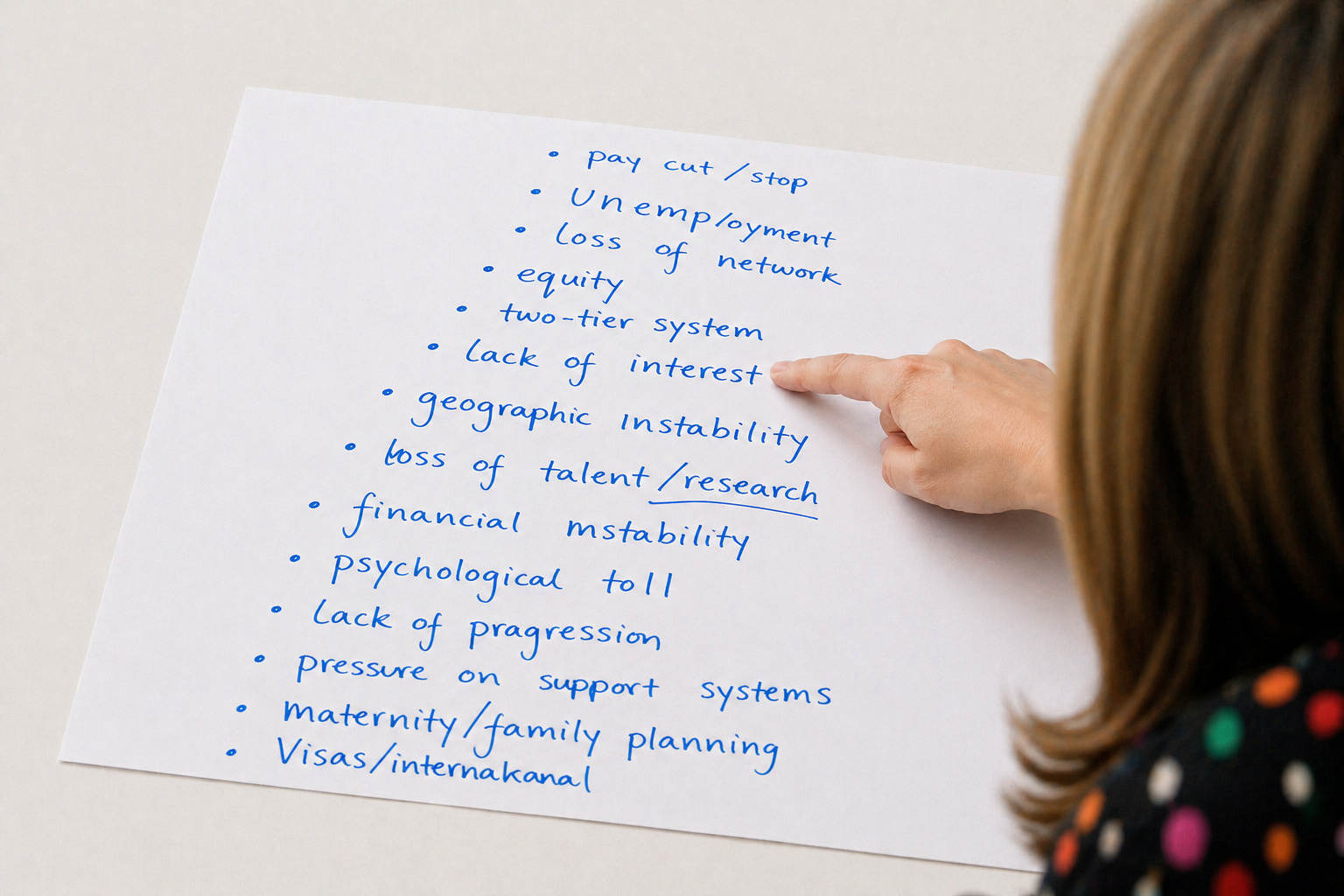
Precarity in research is widespread, driven by reliance on fixed-term contracts, unstable funding, and pressures across the higher education sector. In the UK, around two-thirds (66%) of research staff are employed on fixed-term contracts, reflecting the strong dependence of research activity on time-limited grant funding (UCU analysis). This insecurity affects the wider research community, including researchers at all career stages, teaching-focused roles, technical specialists, professional services staff, and research professionals who support and enable research.
Surveys and discussions with researchers consistently show that these conditions create high levels of stress and uncertainty. Early career researchers often work on contracts that provide limited job security, with over 70% of postdoctoral researchers employed on fixed-term contracts in the UK (UK government analysis). Technicians and research professionals may also experience structural uncertainty through project-based funding, organisational restructuring, and limited career pathways, despite their central role in research.
Many members of the research community report that intense competition, short-term funding cycles, and contractual instability can make workplaces feel unkind, unsafe, or unsustainable. Evidence from Wellcome's research culture survey supports this, with 78% of researchers reporting that high levels of competition create unkind or aggressive working conditions. Precarity is therefore structural and cultural, not just contractual.
About
The Research Precarity Working Group was established in 2025 by Ash Collins, then Senior Research Project Manager of the Wellcome Trust-funded REC-HURDLE project. REC-HURDLE, a £1 million two-year initiative, addressed employment practices contributing to precarious work through reviewing fixed-term contracts, trialling new employment models, expanding career support for early career researchers, and providing targeted resources for underrepresented staff. Ash (they/them) created the Working Group to continue this work and foster collaboration to drive meaningful, sustained change across the research community.
Working Together
Understand impact of policies and use influence to make positive change.
Collaborate to improve systems, share responsibility, and take meaningful action.
Support members, actively campaign, and collaborate to drive systemic change.
Promote good practice, advocate for supportive structures, and share expertise.
Share experiences, contribute to discussions, and help inform sector-wide change.
Latest news
Precarity is undermining research culture
Heavy reliance on fixed-term contracts is weakening collaboration, increasing stress, and making it harder to build sustainable research environments.
Read moreResearch careers built on fixed-term contracts
Nearly two-thirds of research-only staff remain on fixed-term contracts, reinforcing a two-tier academic workforce.
Read moreFlexibility shouldn’t mean insecurity
Project-based research funding drives short-term contracts, but systems could be redesigned to support both flexibility and stability.
Read more